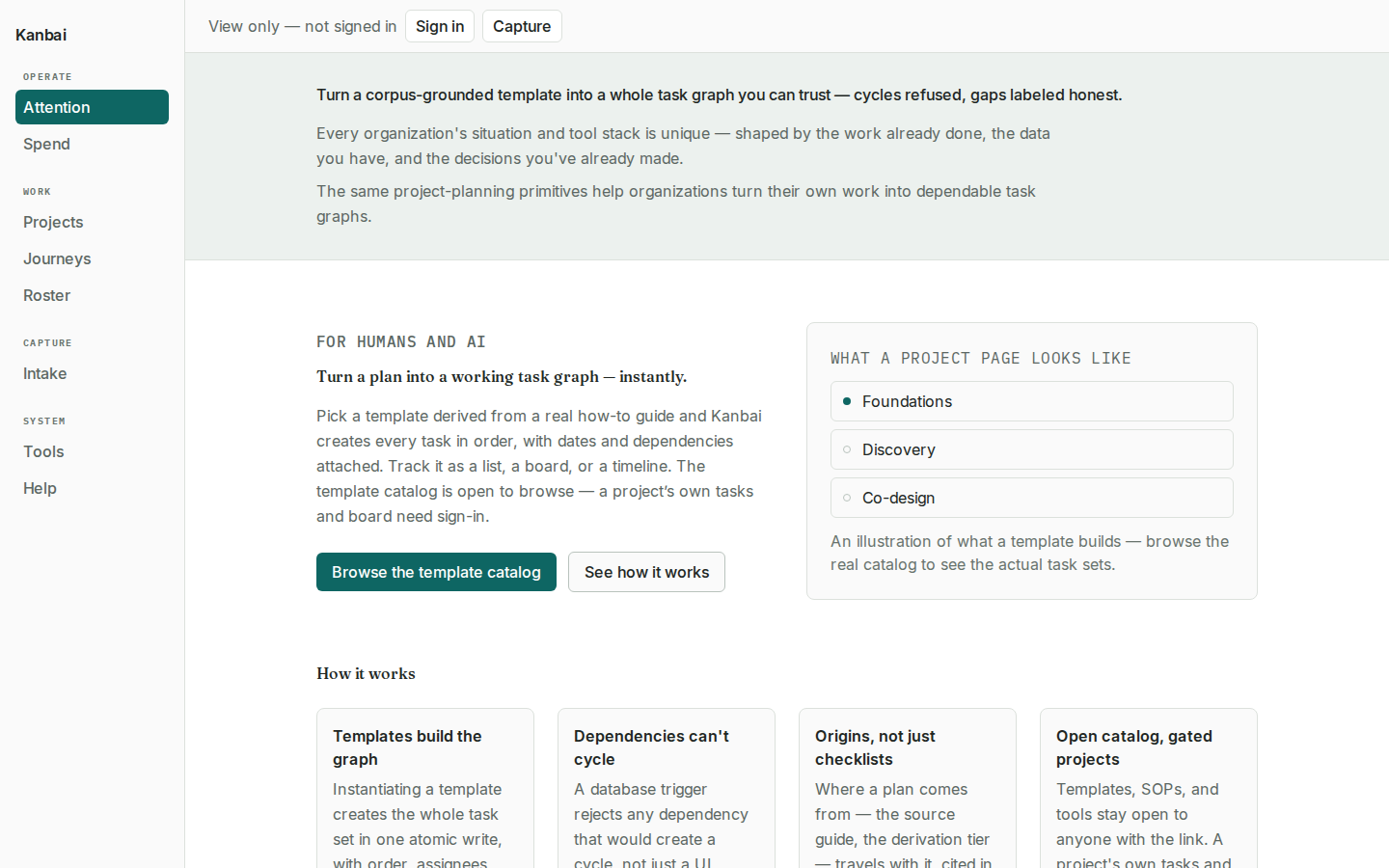
I built Kanbai as a project management application for consultants and practice leads starting client engagements. A client may describe the outcome plainly, but the consultant still has to turn it into tasks, dates, dependencies, ownership, scope, and a statement of work. I wanted those pieces created together from a prepared starting point, with the plan and client documents kept in step.
Kanbai also reflects how the work is staffed. People and AI agents can contribute to the same engagement, so both belong on the same roster and in the same project record. The plan should make ownership plain without forcing the consultant to reconcile separate systems.
The source guide remains attached because a starting plan should be inspectable and correctable. The longer aim is equally practical: a completion claim should become a checked record. Today Kanbai creates dated plans and client paperwork and tracks assignments across people and agents. The aim is for the consultant, team, and client to see what was completed and what was actually checked.
Who it is for
Kanbai is a project management application for consultants and practice leads starting client engagements. It is for the person who must turn a client's request into a credible plan before kickoff, with dates, dependencies, clear ownership, and scope or statement-of-work documents the client can review. The shared roster also suits engagements staffed by people and AI agents.
The problem
Consultants must turn a client's plain-language request into ordered work, dates, dependencies, assignments, and documents the client can approve. A blank project board leaves those pieces to be written and reconciled separately, which takes time and makes omissions easier. When people and AI agents are tracked in different places, it is harder to see who owns the work. Status also becomes unreliable when a claim of completion can be mistaken for work that has actually been checked.
What I built
Kanbai is a project management application that turns a consultant's description of an engagement into a dated plan with ordered dependencies, scope, and statement-of-work documents. Work can be assigned from one roster of people and AI agents, and projects can be followed as a list, board, or timeline. Starting from a public template creates the complete project task set together, avoiding a partial project when creation fails. Kanbai also checks each dependency as it is saved and refuses links that would create a cycle. Each template-derived plan keeps its source guide attached, so its origin remains visible during review and correction. These choices make the plan easier to inspect and protect its basic structure wherever the work is updated.
What is new in it
- A consultant can describe an engagement and get the dated plan, ordered dependencies, scope, and statement-of-work documents together, keeping the delivery plan and client paperwork connected from the start.
- People and AI agents share one roster, so the project records every assignment in the same place and shows whether a person or an agent owns each piece.
- A template creates its full task set together, and every saved dependency is checked for cycles. Failed creation cannot leave a partial project, and circular links are refused.
- Template-derived plans retain their source guide. Consultants and reviewers can see where a plan came from while they inspect it, adapt it, or correct it.
Where it stands
Kanbai is a project management application being built so consultants can move from client request to plan, paperwork, assignment, and a checked record of completion in one flow. The aim is for done to mean the work has been verified, whether a person or an AI agent performed it. The invite-only beta already offers 22 public templates and seven generators without sign-in.